The Best Upanishads Quotes
The Upanishads — Overview
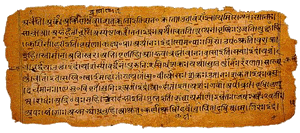 The Upanishads are part of Vedanta or the last part of the Vedas, the oldest scriptures of Hinduism created between 1500–1000 BCE.
The Upanishads contain revealed truth (Sruti) about Brahman (God), the Ultimate Reality and the way of salvation (Moksha).
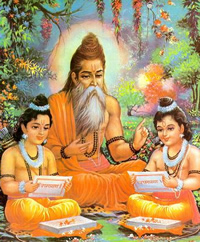 Term Upanishad derives from upa- ('nearby'), ni- ('at the proper place, down') and sad ('to sit') and it means 'sitting near a teacher to receive the sacred teachings'.
The goals of the Upanishads:
1. Makes you realise you are Brahman (take you closer to Brahman)
2. Loosens the bonds of samsara ('wandaring', 'change', a journey of the soul)
3. Destroys ignorance
Vedanta (anta 'the end' or 'last portion') is the essence and culmination of all the knowledge within the Vedas. Vedas (vid - 'to know', 'knowledge' of the eternal truth).
Of the 108 Upanishads that have been preserved 12 are considered the principle Upanishads. The Upanishads most of all are the record of what the sages and seers perceived in thought and visions and are not an organized systems of philosophy. They have elucidated the most important questions of human existence:
Purpose of Life
Nature of Brahman (God)
The Origin of the Universe
Karma
Rebirth
Maya
Afterlife
Immortality
The Upanishads deal the disciplines of philosophical knowledge (jnana), divine love (bhakti), action (karma), and yoga. They express the same truth as the Bhagavad Gita and the Brahma Sutras.

Brahman
Brahman (lit. brih - 'to grow, to expand' also 'the greatest') is God.
The Sanskrit name for God is Sat-Chit-Ananda = Sat (Existence), Chit (Consciousness), Ananda (Bliss). Brahman is Sat-Chit-Ananda in many different forms and God the formless (Existence, Consciousness and Bliss).
Brahman is the Universal Spirit; the Ultimate Reality, Pure Consciousness; the One existence; the Absolute; "the unchanging reality amidst and beyond the world", which "cannot be exactly defined".
The instructions regarding Brahman were often given in short formulas also known as Upanishads.
"Its secret name (Upanishad) is Satyasya Satyam, 'the Truth of truth.' [Brihadaranyaka Upanishad 2.1.20]
The form of that person is like a cloth dyed with turmeric, or like grey sheep's wool, or like the scarlet insect called Indragopa, or like a tongue of fire, or like a white lotus, or like a flash of lightning. He who knows this—his splendour is like a flash of lightning. Now, therefore,
The description of Brahman: "Not this, not this" (Neti, Neti); for there is no other and more appropriate description than this "Not this." Now the designation of Brahman: "The Truth of truth." The vital breath is truth and It (Brahman) is the Truth of that.
— Brihadaranyaka Upanishad 2.3.6
Commentary:
"NOT THIS, NOT THIS": Brahman does not possess any distinguishing marks which can be described by words. By the elimination of all differences due to limiting adjuncts, the words Not This, Not This refer to some thing which has no distinguishing mark such as name, or form, or action, or heterogeneity, or species, or qualities. These two negative particles are used in an all-inclusive sense, so as to eliminate every possible specification that may occur.
All this is Brahman.
(Sarvam khalvidam brahma)
— Chandogya Upanishad 3.14.1
According to Shankaracharya, the sole purpose of the Upanishads is to prove the reality of Brahman and the phenomenality or unreality of the universe of names and forms, and to establish the absolute oneness of the embodied soul and Brahman.
The most famous quote by Shankara from Vivekachudamani ('The Crest Jewel of Discrimination'):
Brahman is the only truth,
the world is unreal,
and
there is ultimately no difference between
Brahman and Atman, individual self.
(Brahma satyam jagat mithya, jivo brahmaiva naparah)
This Vedic truth is not a product of the human mind and cannot be comprehended by the unaided human intellect. Only a competent teacher, through direct experience, can reveal to the qualified student the true significance of the Vedas and the fullness of their absolutely consistent truth.
The Upanishads describe Brahman as having two aspects:
1. Para Brahman, Supreme Brahman is without qualities (Nirguna Brahman)
2. Brahman qualified by limiting conditions (Saguna Brahman)
The ultimate Brahman is devoid of attributes. The entire phenomenal universe is subject to the categories of space, time, and causation; but Brahman, the Supreme Reality, is beyond. In contrast with phenomenal objects, Brahman is not in space but is spaceless. Brahman is not in time but is timeless.
Brahman is not subject to causality but independent of the causal chain. "That which is not destroyed when the upadhis of time, space, and causation are destroyed, is Brahman, the immortal Reality."
In describing Brahman as omnipresent, all-pervading, unlimited, infinitely great and infinitely small, the Upanishads only point out that It is absolutely spaceless.
That which cannot be expressed by speech, but by which speech is expressed—That alone know as Brahman and not that which people here worship.
That which cannot be apprehended by the mind, but by which, they say, the mind is apprehended—That alone know as Brahman and not that which people here worship.
That which cannot be perceived by the eye, but by which the eye is perceived—That alone know as Brahman and not that which people here worship.
That which cannot he heard by the ear, but by which the hearing is perceived—That alone know as Brahman and not that which people here worship. (Kena Up. 1.5-8)
Brahman (the Ultimate Reality; the Universe; the Absolute) is Pure Consciousness and cannot be know by man because it is not an object.
Brahman is the essence of the eye (' the Eye of the eye', 'the Ear of the ear') the mind etc. Brahman — Eternal, Infinite, Unconditioned — cannot be made an object of material, limited and finite senses. The speech cannot define Brahman. Fire, which burns and illumines other objects, cannot burn or illumine itself.
Brahman is known
when It is realized
in every state of mind,
for by such Knowledge
one attains Immortality.
By Atman
one obtains strength,
by Knowledge,
Immortality.
(Kena Up. 2.4)
For example the Upanishads tend to describe qualified Brahman as masculine 'He' and Para Brahman as 'It'.
"That Brahman is called Tadvana, the Adorable of all; It should be worshiped by the name of Tadvana". [Kena Upanishad 4.6]
Great Sayings of the Upanishads - Mahavakyas
The Four Principles Mahavakyas
"Consciousness is Brahman."
prajñānam brahma - (Aitareya Upanishad 3.1.3)
('Consciousness is Ultimate Reality')
"I am Brahman."
aham brahmāsmi - (Brihadaranyaka Upanishad 1.4.10)
"That thou art." - ("You are Brahman.")
Tat Tvam Asi - (Chandogya Upanishad 6.8.7)
"This Self is Brahman."
ayam ātmā brahma - (Mandukya Upanishad 2.)
('This Self' = Atman, the Soul = You.)
Other Mahavakyas
Brahman alone is real; the world is the appearance.
brahma satyam jagan mithyā - (Shankara, Vivekachudamani)
Brahman is one, without a second.
ekam evadvitiyam brahma - (Chāndogya Upaniṣad)
He am I.
So 'ham - (Isha Upanishad)
All this is Brahman.
Sarvam khalvidam brahma. - (Chandogya Upanishad 3.14.1)
The Essence of Vedanta
The most powerful mantra of all Vedantic literature and the essence of all Vedanta is in the Mandukya Upanishads.
Mandukya VII:
Turiya is not that which is conscious of the inner (subjective) world, nor that which is conscious of the outer (objective) world, nor that which is conscious of both, nor that which is a mass of consciousness. It is not simple consciousness nor is It unconsciousness. It is unperceived, unrelated, incomprehensible, uninferable, unthinkable and indescribable. The essence of the Consciousness manifesting as the self in the three states, It is the cessation of all phenomena; It is all peace, all bliss and non—dual. This is what is known as the Fourth (Turiya). This is Atman and this has to be realized.
nāntaḥprajñaṃ na bahiḥprajñaṃ nobhayataḥprajñaṃ na prajñānaghanaṃ na prajñaṃ nāprajñaṃ adṛṣṭamavyavahāryaṃ agrāhyamalakṣaṇaṃ acintyamavyapadeśyaṃ ekātmapratyayasāraṃ prapañcopaśamaṃ śāntaṃ śivamadvaitaṃ caturthaṃ manyante sa ātmā sa vijñeyaḥ. (7)
After describing Consciousness using "Neti-neti" approach, what it is not: "It is unperceived, unrelated, incomprehensible, uninferable, unthinkable and indescribable." the Mandukya describes how it manifests itself:
"It is the cessation of all phenomena; It is all peace, all bliss and non—dual."
prapañcopaśamaṃ śāntaṃ śivamadvaitaṃ
prapañcopaśamaṃ = cessation of all worldly differentiations; it is 'quiescence' = the state of quietness or inactivity.
śāntaṃ = peaceful; (your name is peace not that you’re peaceful);
śivam = blissful; all-auspicious;
advaitaṃ = without a second; (there is no second thing)
Your real Self is the "Silence of the Universe."
"This is what is known as the Fourth (Turiya)."
Imagine three ornaments:
— ring made of gold (1),
— bracelet made of gold (2),
— necklaces made of gold (3).
'The Fourth' is the gold but it is not an independent element but the material out of which all three objects were made. It is called 'the Fourth' but it's not something separate and independent.
Turiya is your 'I-ness".
Turiya is
— Asanga – 'nonattachment'; not attached to anything. It is unattached because you are Consciousness, like light.
— Prakāśakam – 'illuminating'. And object illumined doesn’t affect the light.
— Satyam – Turiya is Reality, three states are mithya (appearances). Appearance cannot affect Reality.
"This is Atman [the Self] and this has to be realized."
Reading is not enough. Reading gives you knowledge and points you to Liberation.
The real nature of Turīya cannot be realized without the negation of the contrary qualities, known as the upādhis, of the three states.
Shankara used the example of the rope.
Walking down a darkened road, a man sees a snake and he is very frightened. On closer inspection he acquires knowledge and realizes that the “snake” was just a piece of coiled rope. Once the illusion (Maya) breaks, the snake vanishes forever. Similarly, ignorant man thinks he suffers and is in bondage. On 'closer inspection' and study he acquires new knowledge and realizes he is Brahman.
You need to realize Brahman as yourself.
If you concentrate deeply on Turiya the mind would go into Samadhi.
Brahman as Sat-Chit-Ananda
One of the most important verses of the Rig Veda (1.164.46) is
The Reality (Truth) is
ONE:
the wise call It by various names.
Ekam sat vipra bahudha vadanti.
All true religions describe the same God but just different paths to find him.
Brahman
is
Ever-Present
Ever-Conscious
Ever-Blissful
The Vedanta often describes Brahman as Sat-Chit-Ananda. Sat (Existence, Reality, Being), Chit (Consciousness, or Knowledge), and Ananda (Bliss).
Existence, Consciousness and Bliss are not attributes of Brahman but Brahman Itself.
SAT (Existence) —
"In the beginning, my dear, this [universe] was Being (Sat) alone, one only without a second."
(Chandogya Upanishad 6.2.1 also Aitareya Upanishad 1.1.1)
"All this that we see in the world is Brahman."
Sanskrit: sarvam khalv idam brahma. (Chandogya Upanishad 3.14.1)
"Brahman is Reality, Knowledge, and Infinity."
(Taittiriya Upanishad 2.1.3) [More...]
The flower, the table, the human being, the feeling exist. Everything exists, everything IS. SAT is the "is-ness" in everything. Everything borrows existence from SAT. Existence (SAT) is the same everywhere – the differences are created by the name and form (Nama, Rupa).
CHIT (Consciousness) —
"Brahman is Consciousness."
Sanskrit: prajnanam brahma. (Aitareya Upanishad 3.1.3)
The core of Yajnavalkya's teachings in the Brihadaranyaka Upanishad is that Brahman, or Atman, is the knowing subject within us.
"Brahman that is immediate and direct
—the Self that is within all."
"You cannot see That which is the Seer of seeing;
you cannot hear That which is the Hearer of hearing;
you cannot think of That which is the Thinker of thought;
you cannot know That which is the Knower of knowledge.
This is your Self, that is within all;
everything else but This is perishable." (Br. Up. 3.4.2)
The image of an object is carried to the brain by a sense-organ, for instance the eye. After passing through various sheaths (kosas), it reaches at last, according to the Hindu psychologists, the sheath of the intellect. There the light of Brahman, or the Self, which is reflected in the intellect, illumines the mental state regarding the object, and thus one becomes aware of it. The mental image of the object is transformed into knowledge of the object. But this mental state is impermanent; therefore the consciousness—which in reality is Brahman— associated with the mental state appears to be impermanent.
ANANADA (Bliss) —
"Brahman is bliss (ananda)."
(Taittiriya Upanishad 3.6.1) [More...]
"The infinite is bliss.
There is no bliss in anything finite.
Only the Infinite is bliss.
One must desire to understand the Infinite." ...
(Chandogya Up. 7.23.1)
When the soul has realised that everything is full of the Lord, of Brahman, it will not care whether it goes to heaven, or hell, or anywhere else; whether it be born again on this earth or in heaven. These things have ceased to have any meaning to that soul, because every place is the same,
every place is the temple of the Lord,
every place has become holy and the presence of the Lord is all that it sees in heaven, or hell, or anywhere else. Neither good nor bad, neither life nor death
— only the one infinite Brahman exists.
According to the Vedanta, when a man has arrived at that perception, he has become free, and he is the only man who is fit to live in this world. Others are not.
The worst punishment according to the Vedas is coming back to earth, having another chance in this world.
Here is the greatest of altars,
the living, conscious human body, and to worship at this altar is far higher than the worship of any dead symbols.
—Swami Vivekananda
More Important Sayings
He who knows the Supreme Brahman verily becomes Brahman. (Mundaka Upanishad 3.2.9)
Brahman is not grasped by the eye, nor by speech, nor by the other senses, nor by penance or good works. A man becomes pure through serenity of intellect; thereupon, in meditation, he beholds Him who is without parts. (Mundaka Upanishad 3.1.8)
"Just as, my dear, by one clod of clay all that is made of clay is known, the modification being only a name, arising from speech, while the truth is that all is clay;
Just as, my dear, by one nugget of gold all that is made of gold is known, the modification being only a name, arising from speech, while the truth is that all is gold...
(Chandogya Upanishad 6:1:2-6)
Chandogya Upanishad 6:2:3:
It (Being, or Brahman) thought:
'May I be many;
may I grow forth.'
Aitareya Upanishad 1.1.1:
In the beginning [all] this verily was Atman only,
one and without a second.
Commentary:
Atman alone, one and without a second, exists both before the creation and during the states of preservation and dissolution. Names and forms, which distinguish the phenomenal universe from the state before the creation, are superimposed upon Atman through maya.
ATMAN:
The word, derived from the root ap, ad, or at, may mean respectively, to obtain or pervade, to eat or enjoy, or to move without ceasing. The term Atman indicates the "Supreme Reality, omniscient, all-powerful, free from all phenomenal characteristics such as hunger and thirst, eternal, pure, illumined, free, unborn, undecaying, deathless, immortal, fearless, and non-dual."
— Shankaracharya
There is One who is the eternal Reality among non-eternal objects, the one [truly] conscious Entity among conscious objects, and who, though non-dual, fulfills the desires of many. Eternal peace belongs to the wise, who perceive Him within themselves—not to others. (Katha Upanishad 2.2.13)
Commentary:
Brahman (God) is the one unchanging ground of the entire phenomenal existence, which is superimposed upon It through avidya. The Lord is the unchanging substratum of the entire changing universe during its creation, preservation, and dissolution. The deities and other living beings derive their intelligence and consciousness from the Supreme Self, as a piece of hot iron derives its power of burning from fire. Without the Consciousness of Atman all beings would become inert.
One enjoys real and everlasting peace only through communion with the Supreme Lord. The bliss that arises from the realization of the Self is no doubt beyond thought and speech, which belong to relative existence; but it is directly experienced by illumined souls. Therefore one should not give up the effort for Self-realization as impossible; one should rather strive with faith and reverence.
Maya ('Illusion')
The Vedas cannot show you Brahman, you are That already; they can only help to take away the veil that hides the truth from our eyes.
The first veil to vanish is ignorance; and
when that is gone,
unskilful behavior goes;
next desire ceases,
selfishness ends, and
all misery disappears.
This cessation of ignorance can only come when I know that
God and I are ONE
in other words, identify yourself with Atman, not with human limitations.
Dis-identify yourself with the body, and all pain will cease. This is the secret of healing. The universe is a case of hypnotisation; de-hypnotise yourself and cease to suffer. In order to be free we have to pass through vice to virtue, and then get rid of both.
Universal Prayer for Enlightenment
Aum.
Asato ma sad-gamaya;
tamaso ma jyotir-gamaya;
mrtyor-ma amrutam gamaya.
Aum.
Shanti, shanti shanti.
[
Aum.
Lead me from unreal to real;
lead me from darkness to light;
lead me from death to immortality.
Aum... peace, peace, peace.]
— Brihadaranyaka Upanishad 1.3.28
Everything in life is transitory.
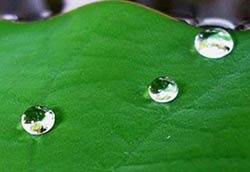
Life is unstable as the water on the lotus leaf.
Therefore if you have enthusiasm for acquiring this knowledge of Atman, do not wait any more but come forward immediately.
Arise! Awake!
and stop not
till
the goal is reached.