The Essence of Bhagavad Gita
Excerpts from God Talks with Arjuna: The Bhagavad Gita
by Paramahansa Yogananda
The Bhagavad Gita — Introduction
The Bhagavad Gita ('the song of the Spirit' or 'the song of the Lord') contains teachings of Bhagavan Krishna in the form of a spiritual dialogue between Sri Krishna and his disciple Arjuna.
The entire knowledge of the cosmos is packed into a mere 700 concise verses of the Gita. The Bhagavad Gita is the sum total of the essence of
— the ponderous four Vedas,
— one hundred and eight Upanishads (voluminous commentaries on the Vedas), and
— the six systems of Hindu philosophy.
 Nature, with her infinite variety and inexorable laws, is an evolute of the Singular Reality through a cosmic delusion: maya, the "Magical Measurer" that makes the One appear as many embracing their own individuality—forms and intelligences existing in apparent separation from their Creator. Just as a dreamer differentiates his one consciousness into many dream beings in a dream world, so God, the Cosmic Dreamer, has separated His consciousness into all the cosmic manifestations, with souls individualized from His own One Being endowed with the egoity to dream their personalized existences within the Nature-ordained drama of the Universal Dream.
The main theme throughout the Gita is that one should be an adherent of sannyasa, a renouncer of this egoity ingrained through avidya, ignorance, within the physical self of man. By renunciation of all desires springing from the ego and its environments, which cause separateness between ego and Spirit; and by reunion with the Cosmic Dreamer through ecstatic yoga meditation, samadhi, man detaches himself from and ultimately dissolves the compellent forces of Nature that perpetuate the delusive dichotomy of the Self and Spirit. In samadhi, the cosmic dream delusion terminates and the ecstatic dream being awakens in oneness with the pure cosmic consciousness of the Supreme Being—ever-existing, ever-conscious, ever-new Bliss.
Self-Realization
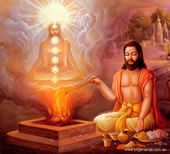
This God-realization cannot be attained merely by reading a book, but only by dwelling every day on the above truth that life is a variety entertainment of dream movies full of the hazards of duality— villains of evil and heroic adventures with goodness; and by deep yoga meditation, uniting human consciousness with God's cosmic consciousness. Thus does the Gita exhort the seeker to right action— physical, mental, and spiritual—toward this goal. We came from God and our ultimate destiny is to return to Him. The end and the means to the end is yoga, the timeless science of God-union. (xvii)
The Bhagavad Gita has a threefold reading:
material,
astral,
spiritual,
applicable to man on all levels of his being,
his body,
mind,
soul.
Incarnate man is encased in a physical body of inert matter, which is animated by a subtle inner astral body of life energy and sensory powers; and both his astral and his physical body have evolved from a causal body of consciousness, which is the fine covering that gives individual existence and form to the soul. The material interpretation of the Gita pertains to the physical and social duties and well-being of man. The astral is from the moral and psychological standpoint—man's character resulting from the astral Nature-born sensory and life-energy principles that influence the formation of habits, inclinations, and desires. And the spiritual interpretation is from the perspective of the divine nature and realization of the soul. (xxvi)
Sri Krishna's message in the Bhagavad Gita is the perfect answer for the modern age, and any age.
Yoga of dutiful action,
of nonattachment, and
of meditation for God-realization.
The path advocated by Sri Krishna in the Bhagavad Gita is the moderate, medium, golden path, both for the busy man of the world and for the highest spiritual aspirant.
Verily, nothing else in this world is as sanctifying as wisdom. In due course of time, the devotee who is successful in yoga will spontaneously realize this within his Self.
—The Bhagavad Gita IV:38
Man's life is a paradox. He is the soul, made in the image of Spirit, which can be satisfied only with divine pleasures; yet bodily incarnate, he is familiar only with sensory experiences. Placed as he is between the material and the spiritual, he must use his endowment of discrimination to distinguish between the real soul pleasures and the illusory pleasures of the senses. Krishna says: "If you want to know the joy of heavenly consciousness vibrating in every cell of the ether, do away with sense attachment!" (bg p.175)
"In this path (of yoga action) there is no loss of the unfinished effort for realization, nor is there creation of contrary effects. Even a tiny bit of this real religion protects one from great fear (the colossal sufferings inherent in the repeated cycles of birth and death)."
—The Bhagavad Gita II:40 [—Commentary]
The Essence of the Bhagavad Gita (the best quotes)
