SELF-REALIZATION
Excerpts from writings by Paramahansa Yogananda

Self-realization is yoga or "oneness" with truth — the direct perception or experience of truth by the all-knowing intuitive faculty of the soul.
"Self-realization is the knowing—in body, mind, and soul—that we are one with the omnipresence of God;
that we do not have to pray that it come to us, that we are not merely near it at all times, but that God's omnipresence is our omnipresence; that we are just as much a part of Him now
as we ever will be.
All we have to do is improve our knowing."
All power of knowing borrows its ability from intuition. The highest expression of intuition is that by which the soul knows Itself: The knower, knowing, and known exist as one. ...
Pure intuition is soul intuition—knowing the soul by the soul; seeing the soul with the eyes of the soul, so to speak. Here there are no modifications of intuition—as the intuition of intellect, or prana, or mind, or matter. The yogi in this state is above them all—knower, knowing, and known having become one. He is fully conscious of his true Self. This is the real soul-consciousness; and, in fact, it is God-consciousness, for the soul is realized as nothing other than the reflection of Spirit. (bg)

The reason that God remains unknown to millions who worship Him in temples and churches, and in holy cities and places of pilgrimage, is that the physical instruments of knowledge can apprehend only the products of the Creator;
Divinity Itself is perceived by the supramental faculty of intuition, the soul's God-given power of knowing truth. When mental restlessness is stilled and the consciousness is interiorized, in touch with the soul, the God-revealing intuitive faculty is awakened. (sc)
Practice the truth you hear and read about, so that it is not just an idea but a conviction born of experience. If reading books on theology satisfies your desire for God, you have not grasped the purpose of religion. Do not settle for intellectual satisfaction about truth. Convert truth into experience, and you will know God through your own Self-realization. (me)
The Highest Branch of All Human Knowledge
This intuitive realization is the king of sciences, the royal secret, the peerless purifier, the essence of dharma (man's righteous duty); it is the direct perception of truth—the imperishable enlightenment—attained through ways (of yoga) very easy to perform.
—The Bhagavad Gita IX:02
Lord Krishna here proclaims Self-realization, true wisdom, as the highest branch of all human knowledge—the king of all sciences, the very essence of dharma ("religion")—for it alone permanently uproots the cause of man's threefold suffering and reveals to him his true nature of Bliss. Self-realization is yoga or "oneness" with truth—the direct perception or experience of truth by the all-knowing intuitive faculty of the soul. This intuitive realization is the basis of all valid religious experience, the very essence of dharma (religion or righteousness), as here stated in the Gita.
The devotee who, through ways of yoga, becomes established in Self-realization possesses the all-knowing intuitive wisdom of direct perception that penetrates to the core of the mystery of how the Lord is at once both immanent and transcendent. Realizing his own oneness with God, the yogi knows that he himself is a microcosm of immanence and transcendence; he remains working in the world without losing awareness of his sublime soul nature, and thus escapes the "evil" of delusive entanglements. (Chapter IX, God Talks With Arjuna: The Bhagavad Gita by Paramahansa Yogananda)
Material Reality vs. Cosmic Consciousness
When in superconscious meditation the heart is calmed, and the yogi can stimulate at will the spiritual center of the medulla or point between the eyebrows, he can control the inner and outer searchlights of perception. When he switches off the lights of the gross senses, all material distractions vanish. Then the ego automatically turns to behold, through the reinforced inner searchlights held by the soul, the forgotten beauty of the inner astral kingdom.
The heart-quieted yogi in superconsciousness becomes able to see visions and great lights; to hear astral sounds; and to become identified with a vast dimly lighted space—alive with glimpses of beauties hitherto unknown.
In the external conscious state, man does not see God's active manifestation as the beautiful Cosmic Energy that is present in every point of space, and that constitutes the luminous building blocks of every object; he perceives only the gross dimensional forms of human faces, of flowers, and of other beauties of nature. The soul coaxes man to turn his attention-searchlights inward to behold, through its astral vision, the ever-burning, ever-changing, multicolored lights of the fountain of Cosmic Energy playing through the pores of all atoms.
The physical beauty of a face, or of nature, is fleeting; its perception depends on the power of the physical eyes. The beauty of Cosmic Energy is everlasting, and can be seen with or without the physical eyes. God makes a grand display of Cosmic Energy in the astral realm of vibratory light. The astral loveliness of roses, scenery, heavenly faces, all play their infinitely fascinating roles of ever-changing colors on the stage of the astral cosmos. Beholding this panorama, the yogi can never again be foolishly attached to the changeable objects of bedimmed beauty in nature, nor expect any everlasting beauty from earth. The most exquisite face wrinkles and droops with age. Roses too must wither, mocking man's desire for any eternal beauty in materiality. Death will destroy the buds of youth; cataclysms will demolish the grandeurs of this earth, but nothing can destroy the splendor of the astral cosmos (and of the still finer ideational world from which emanates all cosmic artistry). The astral atoms assume wonderful forms of light at the mere command of the imagination of one in this subtle realm, and disappear when he so wishes. They wake again, in an ever new garb of beauty, at his call.
The Ascension of Consciousness
In superconsciousness, the physical body, which once seemed so solid and vulnerable, takes on a new dimension composed of energy, light, and thought—a marvelous combination of currents emanating from the elemental creative vibrations of earth, water, fire, air, and ether in the subtle cerebrospinal centers.
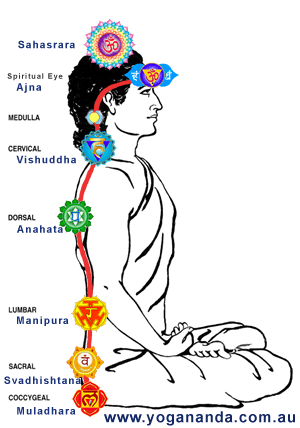 The yogi who moves his consciousness to the coccyx or earth center feels all solid matter to be composed of the atomic and sub-atomic energy of life force, prana.
When the yogi draws his consciousness and energy to the sacral or water center, he experiences all liquid forms to be composed of rivers of electrons of the subtle life force.
When the yogi retires to the lumbar or fire center, he sees all forms of light as made of the cosmic "fire" of prana.
When the yogi retires his consciousness to the dorsal or air center, he sees all gaseous forms and air as made of pure prana.
When the yogi is able to place his consciousness within the cervical or ether* center, he perceives that the subtle etheric background on which grosser forces are imprinted is made of sparks of cosmic intelligent life force, or prana.
* The Sanskrit word akasha, translated as both "ether" and "space," refers specifically to the vibratory element that is the subtlest in the material world, the "screen on which the image of the body and all nature is projected."
When the yogi retires into the medulla center, and into the point between the eyebrows, he knows all matter, energy, and intelligent prana to be composed of thought force. These two centers in the brain are electrical switches of life force and consciousness that are responsible for the creation of the supervitaphone* picture of the body through the action of earth, water, fire, air, and ether—the five elements that compose all matter.
* Vitaphone: an early term for motion-picture films with sound.
Persons whose knowledge comes through books and not through intuition may often speak of matter as thought, yet still remain grossly attached to the body and material limitations. Only the yogi whose knowledge is based on experience, not on imagination—the yogi who can withdraw his consciousness as well as his life force from the body by quieting the heart, taking them through the cerebrospinal centers to the point between the eyebrows—is developed enough to say:
All matter is thought.
Unless consciousness and energy reach the medullary plane, all matter will be experienced as solid, real—quite different from thought no matter how fervently one intellectualizes otherwise. Only upon reaching the medullary plane (through Self-realization acquired by years of yoga practice with the aid of the guru) is one enabled truly to proclaim that all matter is merely the condensed thoughts or visualized dreams of God. And only when one goes beyond superconsciousness to cosmic consciousness can one demonstrate the dream-thought nature of matter. (...)