Katha Upanishad
The Best Quotes
Importance of a Guru
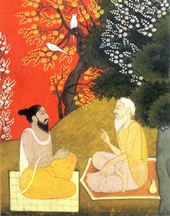 Atman, when taught by an inferior person, is not easily comprehended, because It is diversely regarded by disputants. But when It is taught by him who has become one with Atman, there can remain no more doubt about It. Atman is subtler than the subtlest and not to be known through argument. (1.2.8)
This Knowledge cannot be attained by reasoning. Atman becomes easy of comprehension, O dearest, when taught by another. ... (1.2.9)
Atman: individual soul, the Eternal Self, Pure Consciousness.

Brahman is Aum
Yama said: The goal which all the Vedas declare, which all austerities aim at, and which men desire when they lead the life of continence, I will tell you briefly: it is Aum. (1.2.15)
This syllable Aum is indeed Brahman. This syllable is the Highest. Whosoever knows this syllable obtains all that he desires. (1.2.16)
Nature of Atman
The knowing Self is not born; It does not die. It has not sprung from anything; nothing has sprung from It. Birthless, eternal, everlasting, and ancient, It is not killed when the body is killed. (1.2.18)
If the killer thinks he kills and if the killed man thinks he is killed, neither of these apprehends aright. The Self kills not, nor is It killed. (1.2.19)
Atman, smaller than the small, greater than the great, is hidden in the hearts of all living creatures. A man who is free from desires beholds the majesty of the Self through tranquility of the senses and the mind and becomes free from grief. (1.2.20)
The wise man, having realized Atman as dwelling within impermanent bodies but Itself bodiless, vast, and all-pervading, does not grieve. (1.2.22)
He who has not first turned away from wickedness, who is not tranquil and subdued, and whose mind is not at peace, cannot attain Atman. It is realized only through the Knowledge of Reality. (1.2.24)
Know the atman to be the master of the chariot; the body, the chariot; the buddhi, the charioteer; and the mind, the reins. (1.3.3)
The senses, they say, are the horses; the objects, the roads. The wise call the atman—united with the body, the senses, and the mind —the enjoyer. (1.3.4)
If the buddhi, being related to a mind that is always distracted, loses its discrimination, then the senses become uncontrolled, like the vicious horses of a charioteer. (1.3.5)
But if the buddhi, being related to a mind that is always restrained, possesses discrimination, then the senses come under control, like the good horses of a charioteer. (1.3.6)
Beyond the senses are the objects; beyond the objects is the mind; beyond the mind, the intellect; beyond the intellect, the Great Atman; beyond the Great Atman, the Unmanifest; beyond the Unmanifest, the Purusha. Beyond the Purusha there is nothing: this is the end, the Supreme Goal. (1.3.10)
Path to Realization of Atman
Arise! Awake! Approach the great and learn. Like the sharp edge of a razor is that path, so the wise say—hard to tread and difficult to cross. (1.3.14)
Alternative translation:
Arise, awake from the slumber of Avidya, ignorance; Realize that Atman having approached the exalted teachers; the path is indeed difficult to cross and hard to tread,like the sharp edge of a razor. (1.3.14)
Commentary:
A confused traveller in the desert sees a mirage and runs toward the water in the vain expectation of quenching his thirst. A man in darkness mistakes a rope for a snake and trembles with ill-grounded fear. But when the true nature of the desert and rope is revealed by a wise person, those who were deluded no longer suffer from false expectations and fears. They regain peace of mind. Likewise, a deluded man, who associates Atman with name, form, and the enjoyer of the fruits of action, subjects himself to false expectation and false fear and experiences endless miseries. But when, through the instruction of an illuminated preceptor, he attains the Knowledge of the Self, he becomes free from ignorance, realises the illusory nature of multiple objects, and enjoys peace. (U1;156)
Having realized Atman, which is soundless, intangible, formless, undecaying, and likewise tasteless, eternal, and odourless; having realized That which is without beginning and end, beyond the Great, and unchanging—one is freed from the jaws of death. (1.3.15)
Freed: That is to say, he attains Immortality. The Knowledge of Atman is Immortality: knower becomes Atman. Ignorance of Atman is death; for ignorance produces desire, and desire impels one to action. He goes through the round of births and deaths as long as he cherishes desires, performs actions, and longs for their results. He continues to do so as long as he remains ignorant of his true nature. But when he realises himself to be the infinite Atman, the embodiment of Peace and Blessedness, he then becomes free from ignorance, desire, and action and is emancipated from death.
Children pursue outer pleasures and fall into the net of widespread death; but calm souls, having known what is unshakable Immortality, do not covet any uncertain thing in this world. (2.1.2)
It is through Atman that one knows form, taste, smell, sounds, touches, and carnal pleasures. Is there anything that remains unknown to Atman? This, verily, is That. (2.1.3)
It is through Atman that one perceives all objects in sleep or in the waking state. Having realized the vast, all-pervading Atman, the calm soul does not grieve. (2.1.4)
He who knows the individual soul, the experiencer of the fruits of action, as Atman, always near, and the Lord of the past and the future, will not conceal himself from others. This, verily, is That. (2.1.5)
By the mind alone is Brahman to be realized; then one does not see in It any multiplicity whatsoever. He goes from death to death who sees multiplicity in It. This, verily, is That. (2.1.11)
He is the sun dwelling in the bright heavens. He is the air dwelling in the interspace. He is the fire dwelling on earth. He is the guest dwelling in the house. He dwells in men, in the gods, in truth, in the sky. He is born in the water, on earth, in the sacrifice, on the mountains. He is the True and the Great. (2.2.2)
He it is who sends prana upward and who leads apana downward. All the devas worship that adorable One seated in the middle. (2.2.3)
When the soul, identified with the body and dwelling in it, is torn away from the body, is freed from it, what then remains? This, verily, is That. (2.2.4)
No mortal ever lives by prana, which goes up, nor by apana, which goes down. Men live by something different, on which these two depend. (2.2.5)
All is One, Indivisible, Pure Consciousness
As the same fire assumes different shapes when it consumes objects differing in shape, so does the one Self take the shape of every creature in whom he is present.
As the same air assumes different shapes when it enters objects differing in shape, so does the one Self take the shape of every creature in whom he is present.
As the sun, who is the eye of the world, cannot be tainted by the defects in our eyes or by the objects it looks on, so the one Self, dwelling in all, cannot be tainted by the evils of the world. For this Self transcends all!
The ruler supreme, inner Self of all, multiplies his oneness into many. Eternal joy is theirs who see the Self in their own hearts. To none else does it come!
There is One who is the eternal Reality among non-eternal objects, the one [truly] conscious Entity among conscious objects, and who, though non-dual, fulfils the desires of many. Eternal peace belongs to the wise, who perceive Him within themselves—not to others.
[Alternative translation of 2.2.13:]
Changeless amidst the things that pass away, Pure Consciousness in all who are conscious, the One answers the prayers of many. Eternal peace is theirs who see the Self in their own hearts. To none else does it come!
Commentary:
Brahman (God) is the one unchanging ground of the entire phenomenal existence, which is superimposed upon It through avidya. The Lord is the unchanging substratum of the entire changing universe during its creation, preservation, and dissolution. The deities and other living beings derive their intelligence and consciousness from the Supreme Self, as a piece of hot iron derives its power of burning from fire. Without the Consciousness of Atman all beings would become inert.
One enjoys real and everlasting peace only through communion with the Supreme Lord. The bliss that arises from the realization of the Self is no doubt beyond thought and speech, which belong to relative existence; but it is directly experienced by illumined souls. Therefore one should not give up the effort for Self-realization as impossible; one should rather strive with faith and reverence.
The sages realize that indescribable Supreme Joy as "This is That." How can I realize It? Is It self-luminous? Does It shine brightly, or not?
The sun does not shine there, nor the moon and the stars, nor these lightnings—not to speak of this fire. He shining, everything shines after Him. By His light all this is lighted. (2.2.9-15)
If a man is able to realize Brahman here, before the falling asunder of his body, then he is liberated; if not, he is embodied again in the created worlds. (2.3.4)
Beyond the senses is the mind, beyond the mind is the intellect, higher than the intellect is the Great Atman, higher than the Great Atman is the Unmanifest. (2.3.7)
Beyond the Unmanifest is the Person, all-pervading and imperceptible. Having realized Him, the embodied self becomes liberated and attains Immortality. (2.3.8)
Atman cannot be attained by speech, by the mind, or by the eye. How can It be realized in any other way than by the affirmation of him who says: "He is"? (2.3.12)
When all the ties of the heart are severed here on earth, then the mortal becomes immortal. This much alone is the teaching. (2.3.15)
There are one hundred and one arteries of the heart, one of which pierces the crown of the head. Going upward by it, a man [at death] attains immortality. But when his prana passes out by other arteries, going in different directions, then he is reborn in the world. (2.3.16)
* Commentary by Swami Nikhilananda