Mandukya Upanishad & Karika
Excerpts
Introduction by Adi Shankaracharya:
The Mandukya Upanishad begins with the statement:
“Aum, the word, is all this ”
This treatise, consisting of four chapters, is the epitome of the substance [the oneness of jiva and Brahman] of the import of Vedanta.* ...
[The Mandukya Upanishads contains the essence of the teachings of all Vedanta: "you are One with Brahman (God)".]
What, then, is the end in view?
It is thus explained:
As a man stricken with disease regains his normal health when the disease is removed, so Atman, identifying Itself with misery, recovers Its normal state when the duality manifesting itself as the phenomenal universe is destroyed.**
This realization of Non-duality is the end to be achieved. The manifoldness of duality is produced by avidya; it is destroyed by Vidya (the Knowledge of Brahman). Therefore this treatise is begun for the purpose of revealing the Knowledge of Brahman.
[ * The goal to be attained through the study of the Mandukya Upanishad is Moksha, or Liberation. The means for its attainment is the practice of the Knowledge of the identity of Brahman and Atman. This Knowledge cannot be acquired directly through the study of scripture; yet scripture helps indirectly in this respect by demonstrating the unreality of the phenomenal universe and indicating the reality of Brahman. Thus scripture, too, indirectly helps in the realization of Brahman.
** Self-Knowledge is eternally existent. But it appears to be non-existent on account of man’s identification with the body, the mind, and other factors of the dualistic universe. This is all the result of avidya. Under the influence of this false identification a man regards himself as miserable and seeks happiness. Then, instructed by a compassionate preceptor, he practises the Knowledge of Non-duality, which destroys the illusion of duality. When the obstructions created by duality are removed, he recovers Supreme Bliss, which is the very nature of Atman.]

AUM is All, the Whole Universe
Harih Aum!
AUM, the word, is all this, the whole universe.
A clear explanation of it is as follows: All that is past, present and future is, indeed, AUM.
And whatever else there is, beyond the threefold division of time—that also is truly AUM. (I)
Commentary:
The ultimate identity of AUM and Brahman is thus explained:
The phenomenal world consists of ideas or mental states. Ideas depend upon words for their expression. The utterance of the word AUM (A, U, M) gives the clue to the pronunciation of all words or sounds uttered by human beings. The various parts of the vocal organ that are used in the utterance of all sounds are also used in the pronunciation of AUM.
Therefore AUM is the matrix of all sounds, which in their diversified forms give rise to the words used in language. The sound A, coming from the throat when the mouth opens to utter any word, is the beginning of all sounds. The sound M is the final sound when the lips are closed. And the sound U is the rolling forward of the impulse which has been created in the throat and which ends with the closing of the lips.
Thus when AUM is uttered, all the various parts of the vocal organ needed for uttering words are used. Therefore AUM is said to include all sounds. The substratum of all sounds is AUM, and the substratum of phenomena is Brahman. The sounds signifying the phenomena are non-different from the phenomena, since both are illusory. When the illusion disappears, there remains only the substratum, which is one and admits of no difference.
Therefore it is said that Brahman is AUM.
All This is Brahman
All this is, indeed, Brahman.
This Self (Atman) is Brahman.
This same Atman has four quarters. (II)
Commentary:
These quarters (padas) are as follows:
(1)
Visva, or the waking state;
(2)
Taijasa, or the dream state;
(3)
Prajna, or the state of dreamless sleep; and
(4)
Turiya, or the state of Pure Consciousness, the same as the attributeless Brahman.
The first three quarters correspond to the three matras, or letters, of Aum, namely, A, U, and M. The fourth quarter of Aum, which is known as amatra, or without a letter, has no differentiated sound. It is silence and corresponds to the Turiya state of Atman. The very idea of sound suggests the idea of soundlessness or silence, from which sounds may be said to proceed.
Turiya is here figuratively called a quarter. In reality it does not denote any part. It is Brahman Itself, which does not admit of any differentiation. The knowledge of the fourth quarter is realized by merging in it the previous three. That is to say, the waking state is merged in the dream state, the dream state in dreamless sleep, and finally, dreamless sleep in Turiya, or Pure Consciousness.
"A" — Waking State
The first quarter is called Vaisvanara, whose sphere of activity is the waking state, who is conscious of external objects, who has seven limbs* and nineteen mouths** and who is the experiencer of gross objects.*** (III)
Commentary:
* seven limbs: The word limbs is used here to denote parts of the body. The seven limbs are the head, the eyes, the mouth, the breath, the middle part of the body, the kidney, and the feet. They have their counterparts in the universe, namely, the heavens, the sun, fire, air, akasa, water, and earth. (Compare Chh. Up. V. xviii. 2.)
** nineteen mouths: Namely, the five organs of perception (hearing, touch, sight, taste, and smell), the five organs of action (the organs of speech, grasping, locomotion, generation, and excretion), the five pranas (the vital breath in its five aspects: prana, apana, vyana, samana, and udana), the mind (manas), the intellect (buddhi), I-consciousness (ahamkara), and the mind-stuff (chitta). These are, as it were, the mouths or organs by means of which the waking person (Vaisvanara) experiences gross objects. Like the seven limbs, these also are superimposed, through avidya, upon Atman. The etymological meaning of the word Vaisvanara is “common to all men.”
*** gross objects: Objects of sound, taste, touch, etc. The universe may be regarded from two standpoints: the microcosmic and the macrocosmic.
The microcosmic (subjective) entity (adhyatma) is endowed with four quarters, namely, Vaisvanara or Visva, Taijasa, Prajna, and Turiya.
Likewise the macrocosmic (objective) universe, comprising the spheres of the sun, the moon, the stars, etc., has four quarters. ...
The attributeless Brahman, like Turiya, is the fourth. It is transcendental, beyond all causal relations, and is the unrelated substratum of all appearances.
A parallelism runs through the subjective and the objective. The macrocosm is superimposed upon Brahman, and the microcosm upon Atman, through avidya. Both are illusory appearances. On account of the non-difference between the subjective and the objective, the limbs of Vaisvanara are described in terms of the objective universe. The purpose is to show the illusory nature of the entire phenomenal world and establish the non-duality of Atman and Brahman.
"U" — Dream State
The second quarter is Taijasa, whose sphere of activity is the dream state, who is conscious of internal objects, who is endowed with seven limbs and nineteen mouths and who is the experiencer of subtle objects. (IV)
"M" — Deep Sleep
That is the state of deep sleep wherein one asleep neither desires any object nor sees any dream. The third quarter is Prajna, whose sphere is deep sleep, in whom all experiences become unified, who is, verily, a mass of consciousness, who is full of bliss and experiences bliss and who is the door leading to the knowledge of dreaming and waking. (V)
He is the Lord of all. He is the knower of all. He is the inner controller. He is the source of all; for from him all beings originate and in him they finally disappear. (VI)
Turiya* 'the fourth' — Pure Consciousness
* Turiya, "the fourth" — Pure Consciousness, which both transcends and pervades the tree states of waking, dreaming, and deep sleep. "The Fourth" does not signify a numerical relationship with the three states. Turiya is called the Fourth because It occupies the fourth place in the order of exposition of Brahman.
Turiya is not that which is conscious of the inner (subjective) world, nor that which is conscious of the outer (objective) world, nor that which is conscious of both, nor that which is a mass of consciousness. It is not simple consciousness nor is It unconsciousness. It is unperceived, unrelated, incomprehensible, uninferable, unthinkable and indescribable. The essence of the Consciousness manifesting as the self in the three states, It is the cessation of all phenomena; It is all peace, all bliss and non—dual. This is what is known as the Fourth (Turiya). This is Atman and this has to be realized. (VII)
Read: Gaudapada Karika 1.10-18
Commentary:
Turiya cannot be described by any instrument of empirical knowledge, because of Its unique nature. It is devoid of all characteristics, specific or generic, being one and without a second. Being actionless, It cannot be described by any activity, such as creation, preservation, etc. Then, it may be asked, what purpose is served by the Knowledge of Turiya? Is it not something like the horns of a horse? Not at all.
When a person realizes his self to be Turiya, he is freed from craving for outer objects. He is freed from the false fear and false expectation which plague the phenomenal life. When one knows the true nature of the desert, one no longer runs after the illusory water of the mirage, and when one knows the true nature of the rope, one is not frightened by the idea of the snake falsely superimposed upon it. The realization of the self as Turiya destroys ignorance, desire, attachment, aversion, etc. The gist of the teachings of the Upanishads is the identity of the self and Turiya. Compare: “That thou art” (Chh. Up. VI. viii. 7); “This Atman is Brahman” (Ma. Up. 11); “Atman, indeed is all this” (Chh. Up. VII. vxx. 2). Turiya does not lie outside the three states. ...
It is like the immediate revelation of the rope when the illusory knowledge of the snake is destroyed. When the ignorance that veils the true nature of the rope disappears, the rope is known at once. The knowledge of the rope is not the result of the destruction of the idea of the snake; for the rope has always existed. No other instrument of knowledge is necessary to reveal the rope after the illusory idea of the snake has been destroyed. Likewise, the very destruction of such attributes as subjective consciousness and objective consciousness reveals the reality of Turiya, though the Knowledge of Turiya is not the direct result of the destruction of these attributes. No other instrument of knowledge is necessary for the realization of Turiya.
When Turiya is realized, there no longer remains any distinction between the knower, knowledge, and the known.
Therefore the purpose of the scriptures and other instruments of knowledge is to accomplish the cessation of the attributes mentioned in the text, which is simultaneous with the realization of Turiya. (The various instruments of knowledge employed to explain the non-duality of Brahman really belong to the sphere of duality. The purpose of these instruments is the destruction of duality. When duality is destroyed the instruments of knowledge are also destroyed. Then such factors of realization as the proof and the prover no longer remain. Only Brahman is.)
A + U + M + [ "Silence" ]
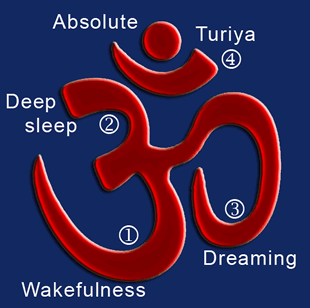 The same Atman explained before as being endowed with four quarters is now described from the standpoint of the syllable AUM. AUM, too, divided into parts, is viewed from the standpoint of letters. The quarters of Atman are the same as the letters of AUM and the letters are the same as the quarters. The letters are A, U and M. (VIII)
Vaisvanara Atman, whose sphere of activity is the waking state, is A, the first letter of AUM, on account of his all— pervasiveness or on account of his being the first. He who knows this obtains all desires and becomes first among the great. (IX)
Taijasa Atman, whose sphere of activity is the dream state, is U, the second letter of AUM, on account of his superiority or intermediateness. He who knows this attains a superior knowledge, receives equal treatment from all and finds in his family no one ignorant of Brahman. (X)
Prajna Atman, whose sphere is deep sleep, is M, the third letter of AUM, because both are the measure and also because in them all become one. He who knows this is able to measure all and also comprehends all within himself. (XI)
Read: Gaudapada Karika 1.19-23
The Fourth (Turiya) is without parts and without relationship; It is the cessation of phenomena; It is all good and non—dual. This AUM is verily Atman. He who knows this merges his self in Atman—yea, he who knows this. (XII)
amātraścaturtho'vyavahāryaḥ prapañcopaśamaḥ śivo'dvaita evamoṅkāra ātmaiva saṃviśatyātmanā''tmānaṃ ya evaṃ veda || 12 ||
Translation 2: That which has no parts (soundless), incomprehensible (with the aid of the senses), the cessation of all phenomena, all bliss and non-dual Aum, is the fourth and verily the same as the Ātman. He who knows this merges his self in the Self.
Translation 3: The transcendental, unitary state of supreme bliss, devoid of all phenomenal existence is the syllable-less, the fourth (aspect) – thus AUṀ is verily the Ātman. By self he enters the Self, who knows thus!
[Here ends Mandukya Upanishad]
Read: Gaudapada Karika starting with 1.24
* Commentary by Swami Nikhilananda